
Which KPIs are truly relevant in B2B lead generation?


Why is cost per lead misleading as a primary metric?
What is the cost per lead?
Cost per lead describes the average cost incurred to generate a single lead. It is calculated by dividing the marketing budget used by the number of leads acquired. The CPL thus shows how efficiently a campaign generates contact data—but says nothing about whether these leads are qualified or will become paying customers.
Why a low CPL is not a reliable indicator of success
Cost per lead (CPL) is one of the most closely watched metrics in B2B marketing. At first glance, low CPL values appear attractive and are often regarded as an indicator of success. However, this perspective is too narrow.
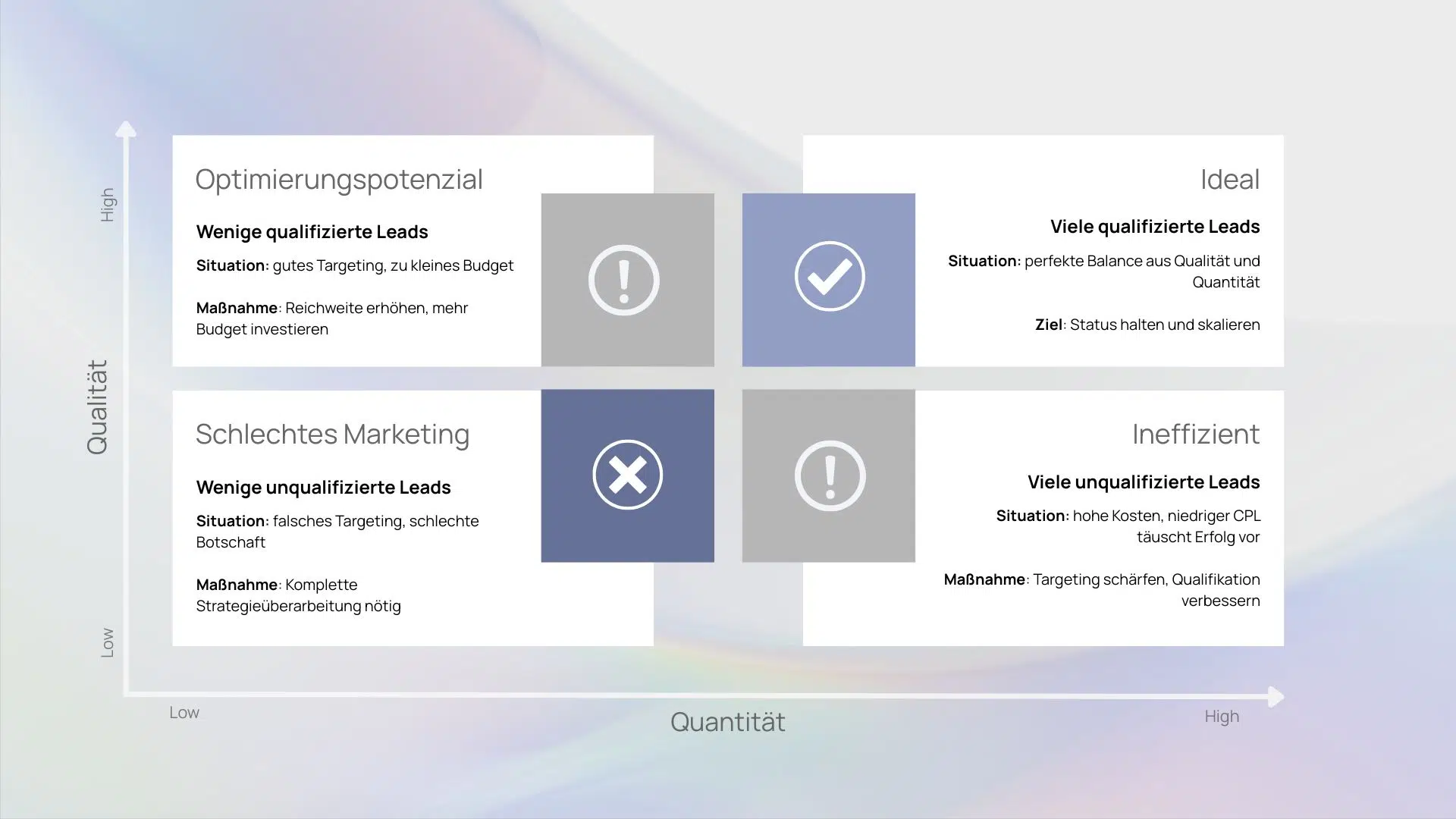
A low CPL simply means that you are collecting contact details cheaply. Whether these contacts actually become customers remains completely open. One company can generate hundreds of leads at five euros each and still not close a single contract. Another pays twenty euros per lead and converts thirty percent of them into paying customers.
CPL alone does not say anything about lead quality. It only measures the efficiency of the initial contact, not the economic value of these contacts. Cost per lead is therefore a classic vanity metric — a metric that looks impressive but says little about actual business success. As soon as you use CPL as your main metric, you automatically optimize for quantity rather than quality. This leads to a funnel full of unqualified leads that cost your sales team time but generate no revenue.
The conversion rate (CR) is also often a focus. How many contacts are generated in relation to the sessions on the website. A high CR often indicates an efficient strategy, but one that only generates non-converting contacts.
Why don't high conversion rates automatically mean success?
At first glance, a rising conversion rate seems like a clear sign of success. More visitors are filling out your form, downloading your white paper, or registering for your webinar. The numbers are steadily increasing. But here, too, the metric is misleading when it comes to actual performance.
High conversion rates can be achieved quickly if you make your offer easily accessible. A free document with no qualification hurdles generates more downloads than a demo request with a callback promise. The question is: Which of these actions actually leads to business deals?
A webinar with a hundred registrations and a fifty percent conversion rate is of little value if only ten percent of the participants belong to the target group. A smaller webinar with twenty highly qualified leads is significantly more valuable. The conversion rate measures activity, not added value.
Summary of problems with traditional KPIs:
- CPL only shows the cost of establishing contact, not the value of the leads.
- High conversion rates are often the result of low qualification barriers.
- Both metrics optimize for quantity rather than quality.
- Sales teams waste time with unqualified leads
- Actual revenue generation remains invisible
Which key figures measure actual success?
The truly decisive KPIs lie deeper in the funnel. They don't measure the number of leads, but rather their quality and conversion potential. These metrics show you whether your marketing is actually contributing to revenue generation.
How can lead quality be systematically evaluated?
Lead quality cannot be determined by quantity alone. It is determined by how well your offering matches the actual needs of your contacts. A qualified lead meets several criteria: they belong to your target group, have a specific problem that your product solves, and have the budget and decision-making authority.
Lead quality is systematically evaluated using lead scoring models. These models assign points based on demographic characteristics (company size, industry, position) and behavioral patterns (pages visited, content downloaded, frequency of interaction). Leads with high scores are given priority treatment.
Complete transparency across the entire lead funnel is achieved when a clearly structured B2B CRM is established as the leading system. Lead status, qualification levels, and contract conclusions are clearly defined and maintained there. GA4 complements this setup with standardized events along the lead generation process and connects marketing touchpoints with CRM statuses. This makes it possible to see which leads have not only been generated, but also qualified, processed by sales, and ultimately developed into customers. Only through this integration is it possible to evaluate in GA4, by acquisition channel or campaign, which marketing measures actually contribute to contract conclusions.
Criteria for high-quality leads:
- Belongs to the defined target group (industry, company size)
- Shows concrete intention to buy
- Has budget and decision-making authority
- Interacts multiple times with relevant content
- Meets minimum lead scoring requirement
- Marked as a sales-qualified lead (SQL)
What does the sales-qualified rate say about the quality of your marketing?
The sales-qualified rate measures the proportion of marketing-generated leads that are classified by sales as worthy of processing. This metric shows the actual quality of your marketing activities more clearly than any conversion rate.
An MQL (marketing qualified lead) has performed certain actions and signaled interest. An SQL (sales qualified lead) has been reviewed by sales and classified as a potential customer. The ratio between the two values reveals the fit between marketing targeting and sales requirements.
A low SQL rate means that your marketing is generating leads, but these leads do not meet the requirements of the sales department. This leads to friction between the two departments and wasted resources. A high SQL rate, on the other hand, shows that marketing and sales are working in harmony.
The SQL rate is optimized through regular communication between marketing and sales. Work together to define what constitutes a qualified lead. Analyze which marketing sources deliver the best SQLs. Adjust your targeting strategies accordingly. This communication is often neglected, but it is essential for digital sales.
Why is the contract conversion rate more important than the lead conversion rate?
The contract conversion rate measures the percentage of SQLs that actually become paying customers. This metric directly links marketing activity to revenue generation. It shows whether you are not only collecting leads, but actually enabling business deals to be closed.
A high contract conversion rate confirms that your marketing is reaching the right people with the right message. Low values, on the other hand, indicate that either the lead quality is insufficient or the sales process has room for improvement.
This metric is analyzed differently depending on the source. Which channel delivers leads with the highest contract conversion rate? Which content formats lead to the most deals? These insights enable strategic budget allocation based on actual business value.
How does time-to-contract reveal funnel efficiency?
Time-to-contract measures the average time from initial contact to contract conclusion. This metric shows how efficiently your entire funnel is working. Long periods indicate friction points in the process, while short periods indicate a well-optimized process.
The time-to-contract analysis is segmented by lead source and channel. Leads from webinars may convert faster than those from content downloads. These differences help you focus your marketing strategy on channels with shorter sales cycles.
Long sales cycles are not necessarily problematic. In the B2B sector, decision-making processes lasting several months are normal. The key is to know the average duration and analyze any deviations. A sudden increase in time-to-contract signals problems in the funnel that need to be identified and resolved.
Why is customer lifetime value the most important long-term metric?
Customer lifetime value (CLV) quantifies the total value that a customer generates over the entire business relationship. This metric shifts the focus from one-time transactions to long-term customer relationships. It shows which marketing channels not only win customers, but also build valuable customer relationships.
A high CLV also justifies higher acquisition costs. If a customer generates revenue over several years, the initial marketing investments can be correspondingly higher. This perspective enables more sustainable budget planning than focusing purely on cost per lead.
An overview of the key KPIs in B2B lead generation:
- Sales-qualified rate shows marketing-sales alignment
- Contract conversion rate links marketing with sales
- Time-to-contract measures funnel efficiency
- Customer lifetime value assesses long-term customer value
- Lead quality determines all subsequent metrics
How do you systematically track and utilize these KPIs?
Capturing these deeper funnel metrics requires a sophisticated tracking infrastructure. Standard analytics tools show you website visits and form submissions, but stop where it gets really interesting: the transformation of leads into customers.
The link between online marketing and offline conversions closes offline conversion tracking. This method transfers data from your CRM back to your marketing platforms. Not only can you see which campaign generated a lead, but also whether that lead became a customer, what contract value they generated, and how long the process took.
Implementation requires technical integration between CRM, analytics, and marketing platforms. Each lead is assigned unique identification characteristics that can be tracked across all systems. Status changes in the CRM (from lead to SQL to customer) are automatically communicated back to the marketing tools.
This database enables informed strategic decisions. You can identify which keywords not only generate clicks but actually lead to contracts being signed. You can see which content formats attract the most valuable customers. You optimize for real business success rather than vanity metrics.
Steps for implementing complete tracking:
- Equip CRM system with unique lead IDs
- Set up GA4 standard events for all funnel stages
- Enable offline conversion tracking between CRM and marketing platforms
- Automate regular data synchronization between systems
- Build dashboards for all relevant KPIs
Conclusion: Focus determines success
Shifting your focus from vanity metrics to real success metrics will transform your entire marketing strategy. Instead of chasing hundreds of unqualified leads, you can concentrate on fewer, but higher-quality contacts. Instead of optimizing for low CPL values, you can invest specifically in channels with high contract conversion rates.
This shift requires a rethink throughout the entire organization:
- Marketing and sales must work more closely together
- The definition of qualified leads must be developed jointly.
- Success is measured based on sales rather than activity.
This makes return on investment much more transparent. Not only do you know how much a lead costs, but also how much revenue different marketing channels actually generate. These insights enable strategic budget allocation based on real business value. This leads to more sustainable growth and more efficient use of your marketing resources.
Further contributions
Updates on our work and our perspectives on the issues that concern us.
We look forward to hearing from you.



Katrin, Maximilian, and Max-Raphael
Managing Partners