
ChatGPT Ads in Germany
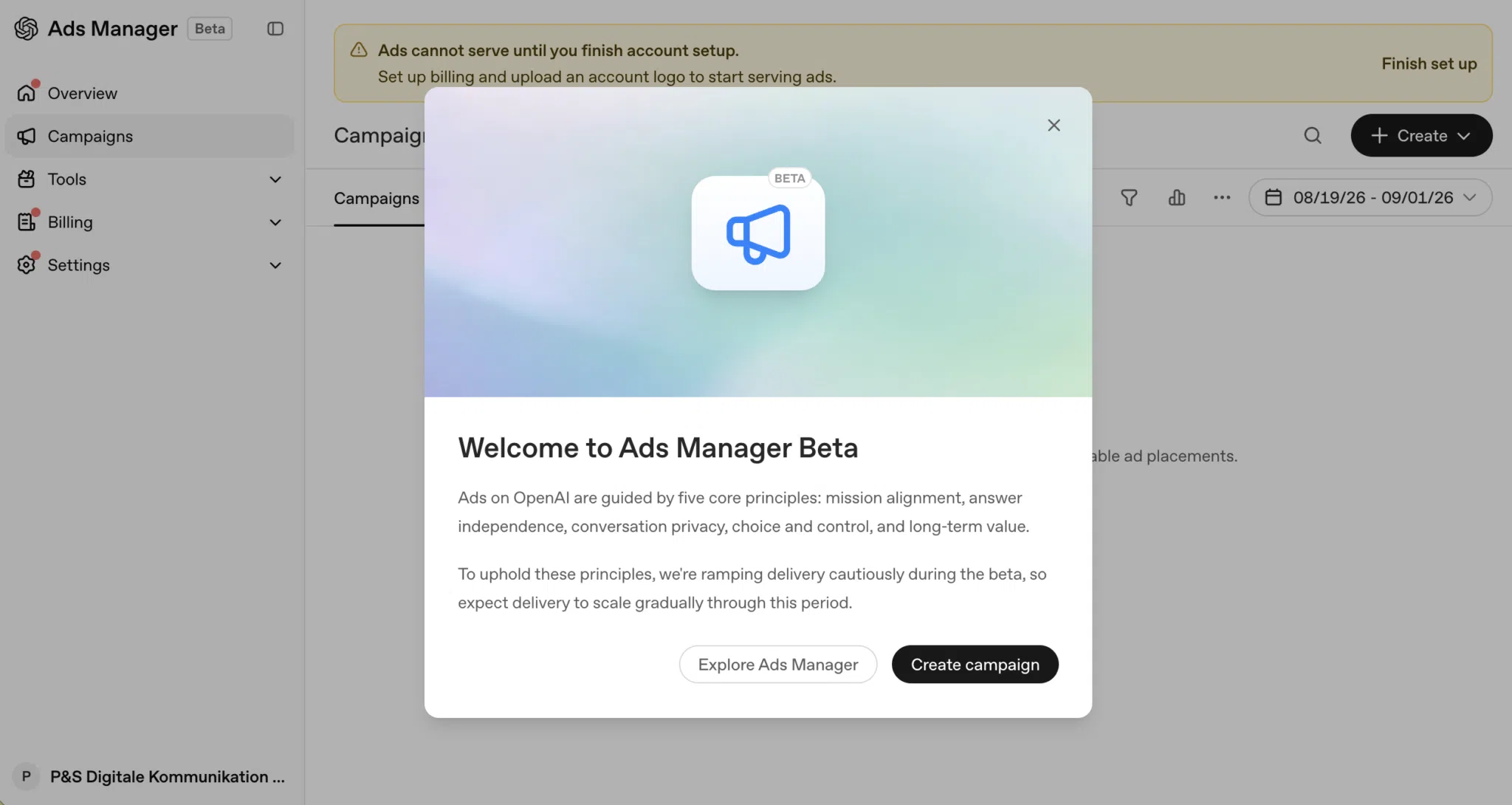
I spent a whole day thoroughly exploring Ads Manager, set up a campaign, implemented tracking, and collected data for the first 24 hours. The results are here: the facts about the launch, my initial numbers, the limitations of the channel, and a section on tracking that’s more honest than the provider would probably like.
In this article, you will learn:
The Most Important Points at a Glance
What Has Actually Been Happening Since August 24
My first numbers after 24 hours
The Advertising Guidelines, or: Who Doesn't Even Need to Start Here
Tracking: Pixels and the Conversions API—and Why It's Not Something You Can Just Do Quickly
Who Should Get Tested
The Most Important Points at a Glance
- Live in Germany and 30 other European markets since August 24, 2026. Self-service via Ads Manager since August 31.
- Reach: Ads are visible only to users on the Free and Go plans. Plus, Pro, and Business plans remain ad-free, as do accounts held by minors.
- Getting Started: Starting at a daily budget of 15 EUR; a free account is all you need; campaign goals include impressions, clicks, or conversions.
- Delivery: No personalized ads at launch in the EEA. Delivery is controlled by country/region and the context of the conversation. No traditional targeting; no topic or placement exclusions.
- My initial metrics: CTR around 1.9 percent, CPC under 1 EUR, CPM between LinkedIn and Meta levels. Conversions after 24 hours on the minimum budget: none.
- Prohibited: Health services outside the U.S., legal and financial services outside the U.S., individual job postings, gambling, political content, and more. A narrow range of consumer services is permitted at launch.
- Tracking: The Pixel and Conversions API exist and work, but they follow their own event taxonomy and normalization rules. Simply copying and pasting from the Meta or Google setup will not work.
What Has Actually Been Happening Since August 24
The ad format is fairly unremarkable. Ads appear as a clearly labeled map below the answer; they do not influence the answer, and they are not intrusive. Anyone who thought ads in the wizard were a nuisance will likely be surprised at first glance by how unobtrusive this solution is.
Ads Manager is well-organized and easy to understand in just twenty minutes. You can manage multiple projects through a single account, and the campaign structure follows the familiar pattern of campaign, ad group, and ad. The minimum daily budget is 15 EUR, which makes the channel accessible even for smaller test budgets.
What’s more interesting is what’s missing. There’s no targeting in the traditional sense—just geographic targeting and contextual cues. I’m still missing exclusion lists for topics or placements in Ads Manager—the kind every media planner is familiar with from Google, Meta, and the established display networks. And the reporting uses rudimentary metrics, without any information about who you’ve reached.
The question of reach comes down to a single sentence in the help section: Ads run only for Free and Go users. Those who use ChatGPT for work generally pay for it and remain ad-free. For B2B providers, this is a crucial piece of information before approving a budget.
My first numbers after 24 hours
Two ads, a minimum budget, and a one-day run. This isn't a statistic, but it's more than the estimates currently circulating.
The click-through rate—at 1.90 and 1.83 percent—was significantly higher than I expected. The version featuring a photo of me performed about twice as well as the alternative. The cost per click was 0.92 and 0.67 EUR, respectively, which is lower than what Google Ads campaigns with comparable content cost. The CPM ranged from 12 to 18 EUR, placing it somewhere between LinkedIn and Meta levels.
The crucial question of whether these clicks actually generate leads or sales cannot be answered reliably after 24 hours on a minimum budget. So far: no. Anyone who claims otherwise after just one day is trying to sell you something.
What the numbers suggest: The channel is inexpensive because it's new and because hardly anyone is bidding on it. This window will close, just as it has closed in every new ad network.
The Advertising Guidelines, or: Who Doesn't Even Need to Start Here
Before considering creative content and budget, it’s worth taking a look at the Ad Policies, which were last updated on August 31. At launch, the permitted scope is narrow: household and consumer goods, local services, travel and entertainment, digital products, and education. Everything else is either blocked or requires manual approval on a case-by-case basis, which is primarily available only in the U.S.
For one of our core industries, the situation is clear. Advertising for healthcare services outside the United States is generally prohibited. The same applies to legal and financial services. Consumer medical devices, wearables, and health apps are explicitly listed among the categories that are permitted only in the U.S.—and even there, only after a case-by-case review. So no one advertises a DiGA in Europe through this channel.
Then there’s the placement issue: Ads don’t appear in discussions about personal or mental health anyway. And because individual job postings are also prohibited, that eliminates the second-most likely reason a practice or medical center would advertise here. Lawyer and legal engineer Daniel Kleiboldt (kleibold.de) has thoroughly analyzed this situation in his newsletter *Caveat*: a marketing decision that is effectively ruled out from three angles at once.
It’s still worth a second look for providers, though, because the restriction applies to “health services.” Business management software sold to medical practices is not a health service. Whether an appointment scheduling or documentation assistant falls under this category is a matter of interpretation—one that OpenAI itself will resolve in case of doubt. And anyone doing planning should take into account that the guidelines have been changed several times since March. A set of rules that changes at this rate is of little use as a basis for planning an annual budget.
One issue that should raise red flags for every healthcare professional remains even if the categories eventually open up: Without topic and placement exclusions, it’s impossible to control the conversational context in which the ad appears. On Google, the ad appears next to a list of search results that looks the same for everyone. In ChatGPT, it appears below a text that a model has just generated specifically for that one person. For topics relevant to the HWG, this is a risk that cannot currently be measured or limited.
Tracking: Pixels and the Conversions API—and Why It's Not Something You Can Just Do in a Flash
The event taxonomy is a separate
The data structures vary by event
The attribution has two unique identifiers
Deduplication is harsh, but unforgivable
And then there are the little things that cost you a Friday night
In practice, this means: The Pixel uses Custom HTML in GTM combined with tag sequencing; for server-side tracking, there are now community templates available for sGTM. And the consent issue remains the same as with any other network—that is, integration into the CMP, clean triggers, and stopping obref sharing upon revocation.
A note on reporting: Click-through and view-through conversions are reported separately. The view-through window is fixed at one day, and these conversions are not included in the "Conversions" metric. Anyone who adds these two figures together without knowing this is overstating the results.
Note: On September 3, 2026, OpenAI announced that it is also planning to introduce a campaign targeting view-through conversions. This means that not only conversions that occur after a click will be counted, but also those from users who had previously seen the ad. The billing model will then be based on impressions. This is a good mix for anyone who wants to combine reach with conversions.
Who Should Get Tested Right Now
I would recommend testing if you: run an e-commerce business selling clearly permitted consumer goods; sell digital products, courses, or software to end customers; operate in the travel or leisure sector; or offer local services that do not fall under the categories of health, law, or finance. With a daily budget of 15 EUR, a meaningful test takes four to six weeks and costs a low three-digit amount. The insights gained are worth it as long as the cost per click remains this low.
I would include it in the marketing mix if: the test shows a viable CPA after four to six weeks with proper conversion tracking, your target audience is clearly in the “Free” and “Go” segments, and you have a budget that you don’t have to divert from search. ChatGPT Ads are not a replacement for a search campaign. It’s a context-based discovery channel, not an intent-based channel.
I would steer clear of this if: you’re a medical practice, medical care center, or hospital; you offer legal or financial services; you want to promote a digital health application (DiGA) or a medical device to end users; or your decision-makers are exclusively on paid plans. For medical practice software providers, there’s a particularly challenging exception: the very people you’re trying to reach don’t see this channel precisely because they use the tool as part of their job.
Regardless of this, here’s something relevant to everyone in the healthcare sector: At the end of August, the European Commission designated ChatGPT as a very large online search engine under the Digital Services Act. As a result, a public advertising archive will be established by January 2027, where ad content, advertisers, time periods, and reach can be looked up. Google and Meta have had this in place for a long time. It simply brings forward the point in time at which you should review your advertising messages.
Do you have any questions?
Together, we’ll determine whether ChatGPT Ads are worth testing for you: We’ll check whether your category is permitted under the advertising guidelines, whether your target audience falls within the Free and Go segments, and how clean conversion tracking can realistically be set up using pixels and the Conversions API. In a no-obligation consultation, we’ll show you where the biggest opportunities lie and where you’d be better off saving your budget. Just get in touch with us.
Frequently Asked Questions About ChatGPT Ads
Further contributions
Updates on our work and our perspectives on the issues that concern us.
We look forward to hearing from you.



Katrin, Maximilian, and Max-Raphael
Managing Partners